From Pigeons to Paysend: A Brief History of Sending Money Home
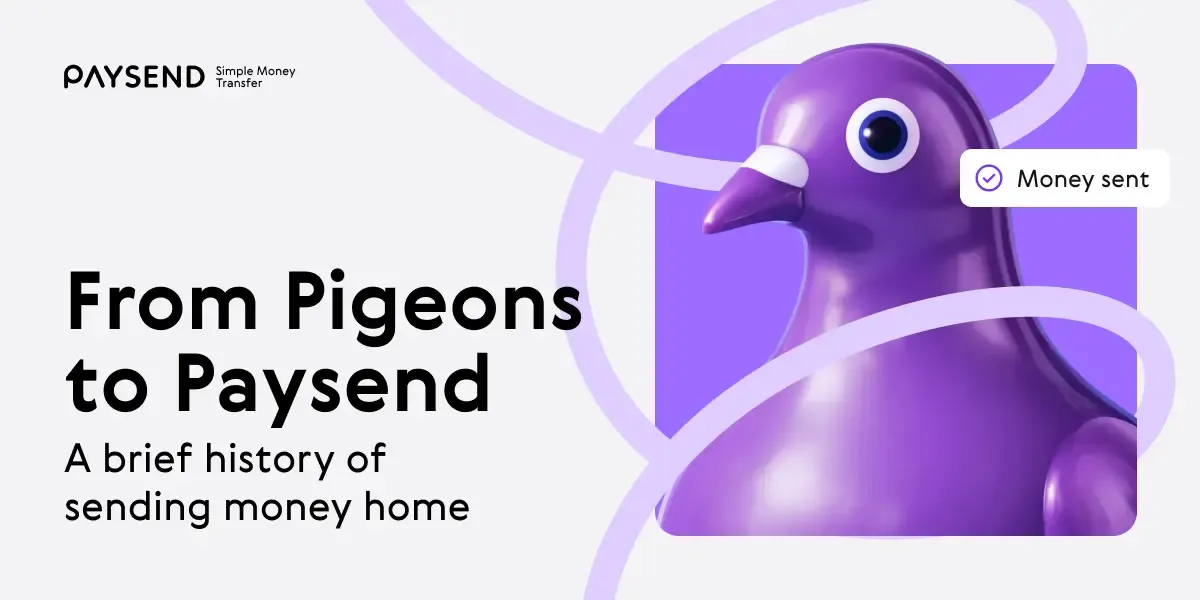
Long before apps, banks, or even paper money, people still had the same need we have today:
to send value across distance.
What’s changed isn’t the motivation — it’s the method.
The Earliest Transfers: Trust and Ingenuity
Centuries ago, money didn’t move digitally — it moved through people, animals, and reputation.
Merchants relied on trusted couriers. Messages and instructions were carried across borders by foot, horse… and yes, even pigeons. Value was transferred not through systems, but through relationships.
It was slow. It was risky. But it worked — because it had to.
The Rise of Informal Networks
As trade expanded, informal systems like hawala emerged. These networks allowed money to move quickly without physically crossing borders, based entirely on trust and local agents.
For many communities, this was revolutionary. Funds could move fast, even where banks didn’t exist.
But informality came at a cost:
- No guarantees
- No transparency
- No protection if something went wrong
Trust lived in people — not in systems.
Banks, Wires, and the Age of Institutions
The 20th century brought formal banking, wire transfers, and global financial institutions. Money became more secure — but also more complicated.
Sending money internationally often meant:
- Visiting a branch
- Filling out forms
- Waiting days for confirmation
- Paying unclear fees
For decades, this was the only “safe” option — even if it wasn’t convenient.
Digital Disruption: When Money Finally Caught Up
Then came the smartphone.
Suddenly, people expected money to move the way messages do —fast, clearly, and from anywhere. Digital remittance platforms began replacing paper forms and long queues with apps and real-time notifications.
This shift wasn’t about novelty. It was about meeting real human needs:
- Urgent support
- Predictable timing
- Transparent costs
From Pigeons to Paysend
Paysend represents the latest chapter in a very old story.
Like the earliest couriers, Paysend is about connection.
Like informal networks, it prioritizes speed.
Like modern banking, it delivers security and compliance.
But unlike anything before it, Paysend brings all of this together — in one simple, mobile-first experience.
Today, sending money home no longer requires waiting, guessing, or hoping for the best. It happens in minutes, with clarity and confidence. Your money will be sent in real time; however, transfer delivery times may vary based on recipient bank processing, compliance checks, or other factors
The Constant Through History
Across centuries and technologies, one thing has never changed:
People send money because they care.
From pigeons to Paysend, the tools may evolve — but the purpose stays the same.
And in 2026, that purpose deserves a solution built for modern life.
With Paysend, you’re not just using the latest technology — you’re part of a long human tradition, made simpler, faster, and more reliable than ever before.
The materials on this blog are provided for informational purposes only and do not reflect the opinions of Central Bank of Kansas City, Member FDIC. Blog posts may contain links to content on third-party websites, which are provided for your convenience; please note that linked sites may have a privacy and security policy different from our own, and we cannot attest to the accuracy of information. The Central Bank of Kansas City does not guarantee nor expressly endorse any particular business, product, service, or third-party content.
Neueste Beiträge
If you're working in one country and supporting family in another, you already know the drill. Payday lands, and the money needs to be with them – not in three working days, not after a bank somewhere in the middle has taken its turn with it. Today, in their hands, ready to spend.
Here's the good news: a card to card transfer sends money straight from your card to someone else's, using the card networks instead of a standard bank transfer. No IBAN, no BIC, no sort code – just a card number. Let's get you sending.

Gute Nachrichten – im September werden die Prämien verdoppelt. Den ganzen September 2026 über bringt Ihnen jeder Freund, den Sie zu Paysend einladen und der die Teilnahmebedingungen erfüllt, 6 USD statt der üblichen 3 USD ein. Laden Sie mehrere Freunde ein, und Sie können diesen Monat bis zu 72 USD verdienen oder den Gegenwert in Ihrer Landeswährung.
Es ist dasselbe Empfehlungsprogramm, das Sie bereits kennen. Bis zum 30. September ist die Prämie einfach doppelt so hoch. So funktioniert es – und so holen Sie das Beste aus der Aktion heraus.


