Credit card to bank transfer: how it works, costs and speed
Here's the short answer: yes, you can use a credit card to get money into someone's bank account abroad. "Credit card to bank transfer" means exactly that — you fund the transfer with your credit card, and your recipient receives it in their bank account. Or on their card, in their wallet, or as cash to collect, depending on where they are.
The card and the bank account do different jobs. Your card pays for the transfer. A provider like Paysend then pays the money out through local systems on the other end. It's one flow, and it takes about a minute in the app.
One thing worth knowing before you start: a credit card is usually the most expensive way to fund a transfer. Some issuers treat it as a cash advance, and credit tends to carry higher payment fees than debit. You'll always see the full cost, exchange rate included, before you confirm anything. What follows is: the ways your money can arrive, what each one costs, how fast it gets there, and the cheaper routes worth checking first.
What "credit card to bank transfer" really means
A credit card to bank transfer is a two-part flow: your credit card funds the transfer, and the money is paid out into a bank account. There's no single wire running from your card to their account — the funding and the payout are separate steps, handled in one go by your provider.
That's worth knowing because two very different things get searched for here. If you're trying to pull cash off your own card, that's a cash advance — the priciest route of the lot, and rarely what you actually need. If you're trying to get money to someone else's bank account, card, or wallet, that's a card-funded transfer, and it's straightforward.
Knowing which one you're doing changes what you pay, whether interest starts immediately, and how fast the money arrives.
Already send card-to-card? It works the same way abroad
If you've used a card number to send money to someone in your own country, you already know how this works. Nothing about it changes when the money crosses a border. You still only need their card number — no IBAN, no SWIFT code, no sort code, no branch details to chase up.
Card delivery covers most of the places Paysend sends to, including Armenia, Azerbaijan, Bangladesh, China, Colombia, Georgia, Guatemala, India, Kazakhstan, Kyrgyzstan, Mexico, Moldova, the Philippines, Poland, Romania, Sri Lanka, Tajikistan, Turkey, Ukraine and Uzbekistan.
Local card schemes are covered too, not just Visa and Mastercard. That means Uzcard and HUMO in Uzbekistan, Elcard in Kyrgyzstan, Korti Milli in Tajikistan, Troy in Turkey, ArCa in Armenia, and UnionPay across several markets — so your recipient can usually use the card they already have, rather than opening something new.
In some places a card is the most direct route there is. In Uzbekistan, money usually arrives on a card — Uzcard, HUMO, Visa, Mastercard or UnionPay — and your recipient doesn't need to share bank details at all.
A few countries run on their own instant-payment schemes instead, and it's worth knowing which. India uses UPI. Brazil uses Pix. Colombia has Bre-B, Moldova has MIA Plăți, and Turkey has FAST. Nigeria pays out to a bank account, cash pickup, or a Paysend Libre account. You'll always see the options available for your recipient before you confirm, so there's nothing to work out in advance.
Can you receive money on a card?
Yes – in many countries, money can be paid out to a card rather than a bank account. On a debit card it arrives as spendable money. On a credit card it arrives as a credit against the balance, which reduces what's owed rather than putting cash in an account. That distinction is worth explaining to whoever you're sending to, because it changes what they can actually do with the money.
Card payout suits some situations better than others. It's a good fit if your recipient banks through their card, doesn't have a full bank account, or wants the money quickly without sharing account details. It's less useful if they need cash in hand, or if the money lands on a credit card when they were expecting something they can spend freely. And it's worth checking their card can receive payments where they are, because not every card and country combination supports it.
There's a third option worth knowing about. In Nigeria, the Philippines and Turkey, money can be received into a Paysend Libre account in US dollars, ready to spend with Apple Pay or Google Pay. That's a useful route if your recipient doesn't have a bank account, or would rather hold dollars than convert straight into local currency.
How card-funded transfers actually work
When you fund a transfer with your card, a few things happen behind the scenes, fast.
Your card gets charged for the amount you're sending, subject to your issuer's rules on that kind of charge.
Then the card networks step in. Visa and Mastercard authorise and process the payment – and this is where Visa Direct and Mastercard Send come in: networks built specifically to move money to eligible cards and accounts quickly, working quite differently to a standard bank transfer.
Finally, the money reaches your recipient. Depending on where they are and how they bank, it lands as a transfer into their bank account, a credit to their card, a deposit into a wallet, or cash to collect.
So no direct card-to-bank wire ever actually happens, even though that's what it looks like from where you're sitting. A traditional cross-border bank transfer usually passes through a chain of intermediary banks along the way. Card-funded transfers use different infrastructure entirely, which can mean fewer steps between you and the person waiting for your money.
Is it safe to send or receive money with a card?
If cards have only ever been a way to pay for things, using one to move money can feel like a leap. It helps to know what's actually happening to your details.
Most people are relaxed about handing over an IBAN and twitchy about handing over a card number. That instinct makes sense — an IBAN only ever receives money, while a card is the thing you type into checkout pages every week. But a card number used to receive money works exactly like an IBAN: it's an identifier, not a key.
A payout to a card is a one-way credit. Sharing a card number so someone can send you money gives them no ability to charge it, and no access to the account behind it. What's never safe to share is your PIN, CVV, or login details — those are the parts that authorise spending. If anyone asks for them, you're being scammed, not sent money. Paysend will never ask for your PIN or your full card credentials.
The networks are built for this. Visa and Mastercard run the payout rails themselves, card details are encrypted, and your recipient never sees your card number when you send. Add proper regulation, card network certification, two-factor authentication at login, and the full cost shown before you confirm, and you've got the checklist for any provider worth using.
Ways to send money funded by a card
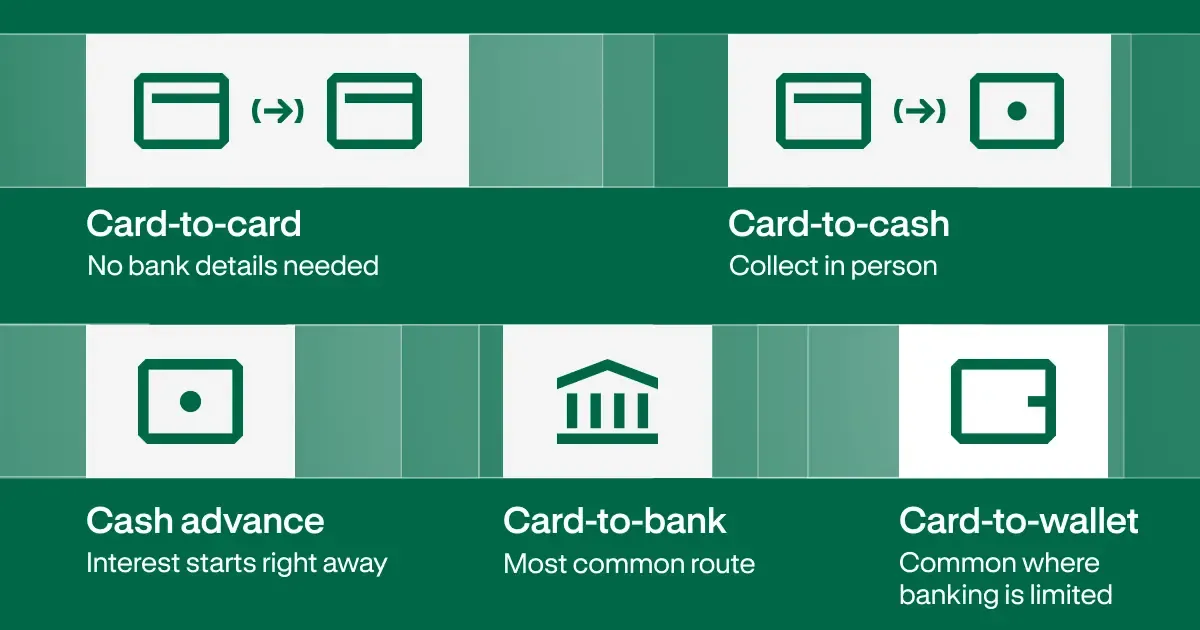
Cash advance
This is what happens when you draw cash against your credit line, through an ATM or a transfer your issuer treats as cash-like. Interest usually starts the moment you take the money out, with none of the grace period you'd get on a normal purchase, and there's often a separate cash advance fee on top.
Card-to-card
Your money moves straight from your card to someone else's, using the card networks rather than bank details. No account number or sort code needed – just their card. It's usually quick, and it's the cheapest of the card routes when you fund it with a debit card.
Card-to-bank
This is the one most people mean by "credit card to bank transfer." You fund it with your card, and the payout completes using local banking systems on the other end – a card funding step, then a normal bank payout. No direct card-to-bank wire in sight.
Card-to-wallet
In some countries, money can go straight into a mobile wallet or fintech account instead of a bank account. It's common where not everyone has full access to traditional banking, and it's often the fastest way for your recipient to actually get and use their money.
Card-to-cash
In several markets your recipient can collect the money as cash instead of receiving it digitally — 10,500+ locations across Mexico, 4,300 in Guatemala, and 500+ in the Philippines, among others. Useful if they'd rather have notes in hand, or don't have an account or card to receive into.
What does it cost – and what costs less?
Funding a transfer with a credit card is typically the most expensive option — issuer cash-advance fees on top of the standard transfer cost. The good news is that none of it is hidden: you see every fee and the exchange rate before you confirm, so you can compare and switch to a cheaper route in the same screen.
What makes a credit card expensive:
The funding method. Credit cards are treated differently to debit cards, which often means a higher payment fee on top of the transfer itself.
How your issuer classifies it. Some treat transfers as cash-like, so interest starts immediately and a cash advance fee can apply. Check your card's terms before you send.
Interest, if you don't clear it. Anything left on the balance keeps costing you after the transfer has arrived.
Where it's going. Sending abroad costs more than sending at home, and the payout method – bank, card, wallet or cash – shifts the total too. Some destinations add a local tax as well: transfers to Brazil, for example, carry IOF where it applies, shown as its own line.
The exchange rate. Sending in another currency? The rate changes what actually turns up on the other end, and rates move for reasons that have nothing to do with your transfer. We've broken that down here.
Cheaper ways to send the same money
Credit-to-bank is one route of several, not the default. Any of these will usually cost you less:
Your debit card. Same speed, same simplicity, lower fee, no interest. This is what we'd recommend for most transfers.
A bank transfer from your account, if you're not in a hurry.
Apple Pay or Google Pay, available in some markets, and just as quick when linked to your debit card.
Your Paysend balance, if you already have funds sitting there.
Card-to-card with a debit card. You only need their card number, and it skips the credit premium entirely.
Change the funding method, change the payout method, or both. You'll see the total for each before you commit.
You should always see the full cost, exchange rate included, before you confirm anything. If a provider won't show you that upfront, take it as your cue to look elsewhere. Fees vary a fair bit between providers and payment methods – our guide to Paysend's fees and bonuses puts ours in one place.
How fast is it?
Speed comes down to which card networks are involved, how the payout completes, and the destination country's own payment systems.
Card-funded transfers can be genuinely fast – often quicker than a traditional international bank wire – because they use networks built for near-instant payouts to cards. Where a country runs its own instant scheme, it's faster still: UPI in India and Pix in Brazil are real-time. Send it online and your transfer starts the second you hit confirm. No branch visit, no phone call.
Fast isn't the same as guaranteed, though. Delivery times vary by route, payout method, recipient bank, time of day, and routine compliance checks. If speed matters this time, check the expected timing before you send. Paying by debit card is just as quick as credit, so speed isn't a reason to reach for the credit card.
Most of it comes down to checking your rate, picking the right payout method, and knowing how to track things once they're moving – here's a full walkthrough.
Disclaimer: Delivery times are not guaranteed and may vary. Time can occur due to compliance or verification checks, funding method, bank or network processing times, or circumstances outside our control.
When a credit card is worth it – and when it isn't
There are moments when a credit card is the right call. If the money needs to go now and your current account is empty, it gets the transfer done. Same if you're covering an emergency for family abroad and know you can clear the balance quickly, or if you're sending outside banking hours when a standard transfer would sit until the next working day. In those situations you're paying for speed and access, and that can be worth it – as long as you've checked the cost first and you're comfortable with it.
Most of the time, though, there's a cheaper option sitting right there. If you have the money on a debit card, use that instead: same speed, lower cost, no interest. If you're just trying to move money into your own account, a standard bank transfer will almost always cost you less. And think about how long you'll carry the balance, because interest has a habit of quietly outgrowing whatever you saved on the transfer fee. Worst case, your issuer treats it as a cash advance – then you're paying a fee and immediate interest on top.
So: if you can pay by debit card, do. Keep the credit card for the moments when nothing else will get the money there in time.
Sending and receiving money with Paysend
With Paysend, how you pay and how they get paid are two separate choices — and you'll see every combination, with the full cost, before you confirm.
How you can pay: credit card, debit card, bank transfer, your Paysend balance, or Apple Pay and Google Pay in some markets.
Where the money can land: their bank account, their card (local or international), a digital wallet, or cash to collect. In Nigeria, the Philippines and Turkey, they can also receive US dollars into a Paysend Libre account and spend it straight away with Apple Pay or Google Pay.
For card payouts you often won't need their full international bank details at all – just their card number.
Behind the scenes, Paysend uses card network infrastructure to move funds directly to eligible cards in many countries, alongside payouts to bank accounts, local instant schemes, wallets and cash. That's a different path to a traditional cross-border bank transfer, where your money typically passes through a chain of intermediary banks.
FAQ
Can you transfer money from a credit card to a bank account?
Yes — you fund the transfer with your credit card, and your provider pays it out into the recipient's bank account. It's two steps handled in one flow, not a single card-to-bank wire. A debit card usually does the same job for less.
I already send money to a card in my own country. Does it work internationally?
Yes, and the process is the same – you'll still only need your recipient's card number. What varies is whether their country and bank support card payouts, so some routes pay out to a card and others to a bank account, wallet or cash. You'll see the available options for your recipient before you confirm.
Can I receive money on a card?
In many countries, yes. On a debit card it arrives as spendable money. On a credit card it arrives as a credit against the balance rather than as cash in an account. In Nigeria, the Philippines and Turkey you can also receive US dollars into a Paysend Libre account and spend it with Apple Pay or Google Pay.
Is it safe to share my card number to receive money?
Yes. A card number works like an IBAN here — it can receive money, not take it. Your PIN, CVV and login details are the ones to protect, and no legitimate provider will ask for them.
Should I send to a card or a bank account?
Card payout is usually quicker to set up and quicker to arrive, and you only need their card number. Bank payout is the right call where card payout isn't supported, or if your recipient wants the money in their main account. You'll see which options are available for them before you confirm.
How do I transfer money from a credit card to a bank account?
Pick a provider that lets you fund a transfer by card, enter your recipient's bank details or card number, check the total and confirm. The payout completes through local banking systems on the other end.
Can you transfer cash from a credit card to a bank account?
Withdrawing cash against your credit line is a cash advance — interest usually starts immediately, often with a separate fee. A card-funded transfer is cheaper and more practical if what you actually need is money in someone's account.
Is transferring money from a credit card the same as a cash advance?
Not necessarily. A cash advance draws cash against your credit line with interest starting immediately. Funding a transfer through a provider built for it is a different process with different costs – but some issuers still classify it as cash-like, so check your terms.
Can I transfer money from a credit card to a bank account instantly?
Often, yes – card networks are built for quick payouts, and schemes like UPI and Pix are real-time. Timing still depends on the destination and your recipient's bank or wallet, so it's rarely guaranteed to be instant.
Is it cheaper to use a debit card or a credit card?
A debit card, almost always. Credit cards can carry higher payment fees, and some issuers charge interest immediately if they treat the transaction as cash-like.
What's the cheapest way to send money abroad?
It depends on the corridor, but funding with a debit card and paying out to a card, bank account, wallet or cash is usually cheaper than using a credit card. Compare the total cost with the exchange rate included, not just the headline fee.
Can I send money from a credit card to a bank account in India?
Yes. You fund the transfer with your card, and the money is paid out by UPI, to a Visa or Mastercard card, or straight into an Indian bank account – Paysend supports 100+ Indian banks, including SBI, HDFC Bank, ICICI Bank, Axis Bank and Punjab National Bank. UPI has a cap of ₹100,000 per transfer.
Can I send money to a wallet instead of a bank account?
Yes, in many countries. Wallet payouts include GCash and Maya in the Philippines, bKash, Rocket and Nagad in Bangladesh, Nequi, Daviplata and RappiPay in Colombia, PicPay and Mercado Pago in Brazil, eZ Cash and mCash in Sri Lanka, and Alipay and WeChat Pay in China. You'll see which options are available for your recipient before you confirm.
Can my recipient collect the money as cash?
In several markets, yes — including 10,500+ locations in Mexico, 4,300 in Guatemala, and 500+ in the Philippines. Cash pickup is also available in Nigeria.
Does it affect your credit score?
It can, especially if it's treated as a cash advance, since that eats into how much of your available credit you're using. Check with your issuer if you're not sure how they'll treat it.
Do all banks and providers let you fund a transfer with a credit card?
No. Some banks don't support it at all, and those that do may set their own limits and fees. Worth checking before you count on it for a transfer that can't wait.
Neueste Beiträge

Jeden Monat schicken Tausende Menschen, die in Tschechien arbeiten, einen Teil ihres Gehalts nach Hause – viele von ihnen sind Ukrainer, die Familie jenseits der Grenze unterstützen. Und der klassische Weg macht es schwerer, als es sein müsste: Banküberweisungen, die IBAN und SWIFT-Codes verlangen, Gebühren, die erst sichtbar werden, wenn das Geld schon weg ist, und tagelanges Warten, während zu Hause jemand darauf angewiesen ist.
Pavel Štich hilft seinen Lesern seit Jahren genau dabei, dieses Problem zu lösen. Er ist Mitgründer und Chefredakteur für Finanzen bei Moneyo.cz, einer unabhängigen tschechischen Plattform, die Geldtransferdienste, Aktienbroker und alternative Investments vergleicht – und Paysend-Botschafter, was bedeutet: Er testet selbst, was er empfiehlt, erklärt es verständlich und bietet seinen Lesern exklusive Vorteile. Wir haben ihn gefragt, wie Moneyo entstanden ist, wer die Plattform liest und warum er sich für Paysend entschieden hat.

Der Schulanfang ist eine der Zeiten im Jahr, in denen man die Entfernung zu seinen Liebsten besonders spürt. Gleichzeitig gehört er für viele Familien zu den teuersten Phasen des Jahres: Schulmaterial, Uniformen, Schulgebühren und alltägliche Ausgaben fallen oft zur gleichen Zeit an. Viele Menschen unterstützen ihre Familien im Ausland, indem sie Geld nach Hause senden, um diese Kosten zu decken. Deshalb können neue Paysend-Kunden zum Schulanfang ihre erste Überweisung ohne Gebühren und zu einem günstigeren Wechselkurs tätigen.
Ganz gleich, ob Sie bei Schulgebühren helfen oder alltägliche Ausgaben mitfinanzieren: Mit einer internationalen Überweisung können Sie Ihre Angehörigen genau dann unterstützen, wenn sie Ihre Hilfe brauchen. Mit Paysend können Sie Geld in mehr als 170 Länder senden und dabei sichere und unkomplizierte Zahlungsmethoden nutzen. Hier erfahren Sie, wie Sie sich kostenlos registrieren und das Angebot nutzen können.


