Meet Pavel Štich: Helping Czech and Slovak readers send money home
Every month, thousands of people working in the Czech Republic send part of their payday home — many of them Ukrainians supporting family across the border. And the traditional route makes it harder than it should be: bank wires that ask for IBANs and SWIFT codes, fees that only show up after the money's gone, and days of waiting while someone at home is counting on it.
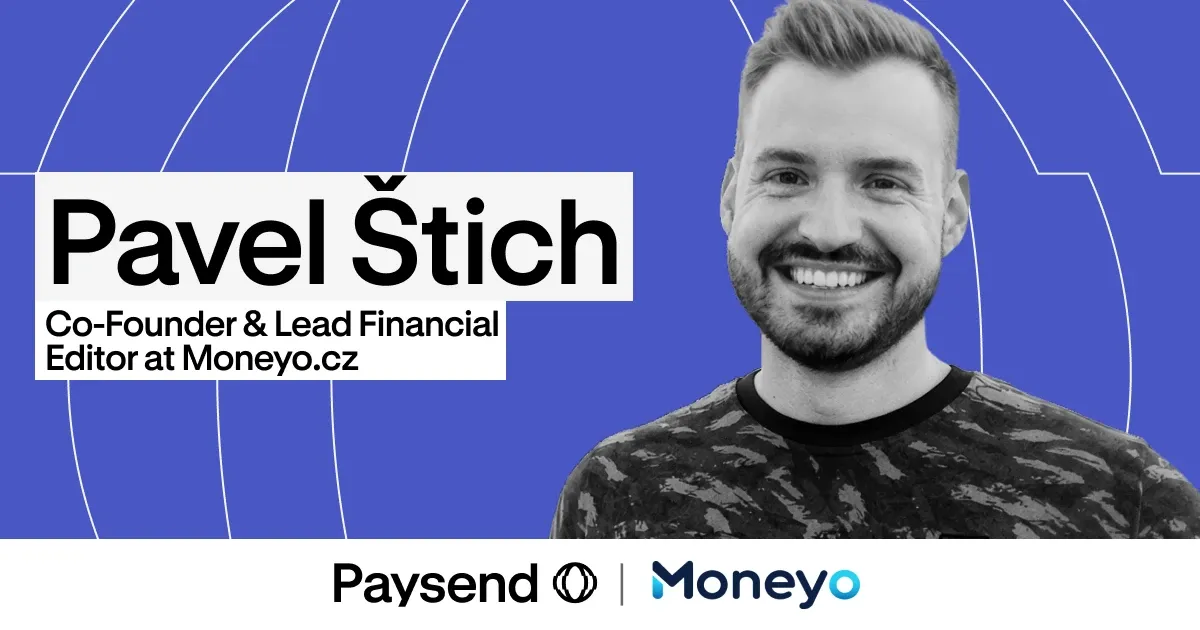
Pavel Štich has spent years helping his readers solve exactly that. He's Co-Founder and Lead Financial Editor at Moneyo.cz, an independent Czech platform that compares money transfer services, stock brokers, and alternative investments — and a Paysend Ambassador, which means he tests what he recommends, explains it plainly, and brings his readers reader-only perks. We asked him how Moneyo started, who reads it, and why he chose Paysend.
Why did Pavel start Moneyo.cz?
Pavel co-founded Moneyo.cz with his older brother, Vlastimil. The goal was simple: help people make better financial decisions, in plain language.
"We started Moneyo to create an independent, transparent platform that helps Czech and Slovak readers make smarter financial decisions without getting lost in complex banking jargon, hidden fees, or aggressive marketing."
The problem he set out to fix is one we recognise. As Pavel puts it:
"Many traditional financial services, brokers, and money transfer providers hide their real costs behind spread markups, hidden fees, or confusing terms."
Moneyo answers that with hands-on reviews and independent comparisons — international transfers, brokers, and alternative assets from crypto to investment whisky.
Who the Moneyo community is
Moneyo's readers are Czech and Slovak savers, investors, cross-border workers, and expats. It also includes a large group with a very specific need.
"In the Czech Republic, there is also a very large community of Ukrainian citizens working here who are actively looking for fast, reliable, and cost-effective ways to send money home to their families in Ukraine."
Those readers come to Moneyo for clear fee breakdowns, broker comparisons, alternative investment guides, and verified promo codes. Moneyo now serves tens of thousands of monthly readers across the CZ/SK region.
How Pavel decides what to recommend
Trust is the whole product. Before Moneyo recommends anything, the team:
- Tests every service hands-on
- Verifies regulatory licences (FCA, CNB, EU regulations)
- Analyses real exchange rates, spreads, and fees
- Recommends only what they would use themselves
"We only recommend platforms we would personally use and feel confident recommending to family and friends."
Not many services pass that test. It's why this partnership matters to us.
How Pavel found Paysend
Pavel found Paysend while looking for a faster, fairer alternative to traditional bank SWIFT transfers. What convinced him was Card-to-Card.
"Being able to send money directly to a debit card fast with a low, flat fee was a game-changer."
His first transfer made the point.
"Instead of asking for complicated IBANs or SWIFT codes and waiting days for bank processing, the transfer arrived on their card in under a minute."
What changed after switching to Paysend?
Four things changed: how he sends, what it costs, how long it takes, and what details he needs.
| Before Paysend | With Paysend |
| Bank wire transfers or remittance outlets | Transfers from a smartphone or browser |
| High fees and hidden exchange markups | The total, shown before you send |
| Multi-day delays | Most Card-to-Card transfers arrive in seconds — up to 3 business days if the recipient's bank needs extra time or runs security checks |
| IBANs and SWIFT codes | Card number only |
What he values most:
"The simplicity of Card-to-Card transfers, instant delivery times, upfront fee transparency, and competitive exchange rates. You always see the exact amount the recipient receives before hitting send."
How does Paysend help Ukrainians in Czechia send money home?
This is where Moneyo's readers and Paysend's purpose meet. For Ukrainian workers in Czechia, sending money home isn't a financial product decision — it's family.
"Paysend allows them to transfer money directly to Ukrainian bank cards (like PrivatBank or Monobank) in seconds, without high bank fees or complicated SWIFT procedures."
Moneyo readers tell Pavel the same things: it's simpler than a bank, and the money arrives fast.
Why Pavel became a Paysend Ambassador
He was already recommending Paysend before we ever spoke.
"We were already genuinely recommending Paysend on Moneyo based on our positive personal experiences. Becoming an official Ambassador allows us to work directly with the Paysend team, offer exclusive reader perks, and help even more people transfer money smarter."
The Paysend Ambassador Programme is built for exactly this: people with real community trust, not just reach. Ambassadors earn rewards for the people they introduce, and their communities get something back too.
What's next for Paysend and Moneyo
Pavel's plan for the partnership:
Paysend works with ambassadors and their communities to keep learning what senders actually need — and to keep improving the experience around it. Ambassadors like Pavel are close to the people we serve; what they hear shapes what we build.
“For me, Paysend means fast, transparent, and stress-free international money transfers for everyone.”
Where to find Moneyo
- Moneyo.cz — the main site
- Moneyo's Paysend review
- Paysend promo code guide (CZ)
- Paysend promo code guide (UA)
Become a Paysend Ambassador
If you have a community that trusts you — a blog, a group, a newsletter, a network of friends sending money home — we'd like to hear from you. Apply at paysend.com/ambassador.
Frequently asked questions
What is Moneyo.cz?
Moneyo.cz is an independent Czech financial platform co-founded by brothers Pavel and Vlastimil. It publishes transparent comparisons of financial services, stock brokers, money transfers, and alternative investments such as cryptocurrencies and whisky.
Who is Pavel Štich?
Pavel Štich is Co-Founder and Lead Financial Editor at Moneyo.cz, and a Paysend Ambassador. He writes about fintech, stock investing, alternative assets, and international payments for readers across the Czech Republic and Slovakia.
How do Ukrainian workers in Czechia send money home with Paysend?
They send directly to a Ukrainian bank card, including PrivatBank and Monobank cards. No IBAN or SWIFT code needed — just the recipient's card number.
What is Card-to-Card?
Card-to-Card is a Paysend transfer sent straight to a recipient's debit card using their card number. You'll see the fee and the amount they'll get before you confirm. Most transfers arrive in seconds. It can take up to 3 business days if the recipient's bank needs extra time or runs security checks.
What is the Paysend Ambassador Programme?
It's a selective programme for people with genuine community trust — creators, editors, and community organisers — who introduce Paysend to their audience and earn rewards for it. Apply at paysend.com/ambassador.
Do Moneyo readers get a special offer?
Yes, and it comes in two parts. Their first transfer has no Paysend transfer fee. Then, when their second transfer is $100 or more, they get $5 — or the equivalent in their local currency. Terms apply.
Publikasi Terbaru

Sending money abroad shouldn't mean queuing in a bank branch and filling out forms with codes you may never have heard of. An international money transfer moves your money from your account, card, or wallet in the US to someone else's account, card, or wallet in another country, and, above all, it should be simple, transparent, and reliable enough that you don't have to think twice about it.
Whether you're supporting family back home, paying for something abroad, or sending a gift for a birthday you can't be there for in person, the reason you're sending matters more than the mechanics. If you're new to Paysend, your first transfer comes with zero fee and a special exchange rate, so more of what you send actually arrives, and we'll show you how to claim it.

Sending money digitally is quick and convenient, but it also involves important security, verification, and fraud prevention checks. In most cases these checks happen automatically in the background.
If you’ve ever wondered why Paysend asks you to verify your identity, why a transfer might be reviewed, or how your money is protected, the answer is simple: these processes are designed to keep you, your money, and your recipient safe.
Every digital money transfer relies on trust, regulation, and security systems working together. While these checks can sometimes feel like an extra step, they are a standard and essential part of how modern money transfers stay secure.


