Case Study: Remozo – Scaling Global Freelancer Payroll with Paysend Enterprise
About Remozo
Remоzo (Apzone Ltd, Cyprus) is a global hiring & payroll platform. It helps companies to manage international talent through Contractor-of-Record (COR) and Employer-of-Record (EOR) solutions.
Remozo’s mission is to simplify cross-border work by enabling businesses to hire, onboard, manage, and pay contractors or full-time employees in over 190 countries.
Click here to learn more about Remozo’s capabilities.
The Need
As a fast-scaling EOR platform, Remozo needed a global payout solution that could:
- Deliver fast, reliable payments across multiple regions.
- Access hard-to-reach markets often underserved by traditional providers.
- Offer multiple payout options including direct-to-account and card-based payments.
- Scale with their international expansion and diverse freelancer base.
Existing providers were unable to deliver both the coverage and speed Remozo required, limiting their ability to differentiate and meet client needs.
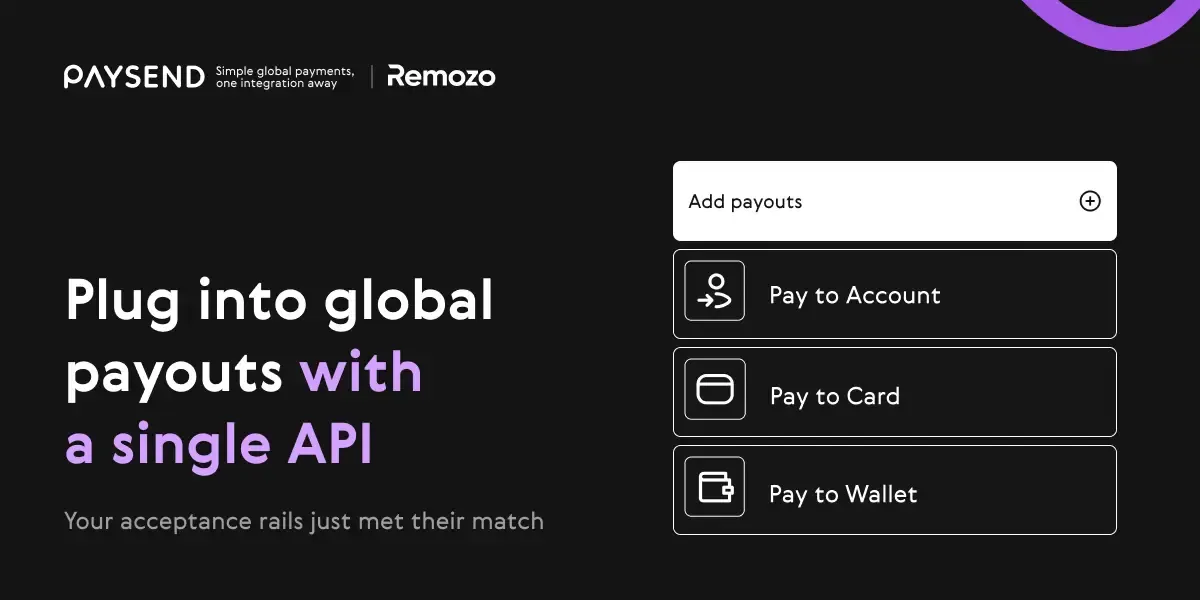
The Solution: Paysend Enterprise API
Remozo integrated the Paysend Enterprise API, gaining direct access to Paysend’s global payout network spanning 170 corridors and 80 currencies, powered by 48 regulatory licenses worldwide.
Through Paysend’s API, Remozo can offer its clients:
- Bank payouts – secure direct-to-account transfers in multiple currencies.
- Original Credit Transactions (OCT) card payouts – instant payments to Mastercard, Visa, and key local schemes including Uzcard (Uzbekistan), Korti Milli (Tajikistan), Humo (Uzbekistan), and Unionpay (China).
- Expanded coverage in underserved regions, providing a competitive edge in emerging markets.
The Outcome
Since launching with Paysend in July 2025, Remozo has achieved:
- Accelerated global coverage – unlocking access to regions competitors struggle to serve.
- Improved freelancer experience – faster, more stable payment options for global contractors.
- Rapid growth – transaction volumes and client adoption have grown significantly within the first months of integration.
- Market differentiation – positioning Remozo as a leading EOR platform for seamless international payroll.
- Significant growth – since launching with Paysend Remozo’s volumes have grown significantly showing steady month on month growth of over 100%.
Remozo Testimonial
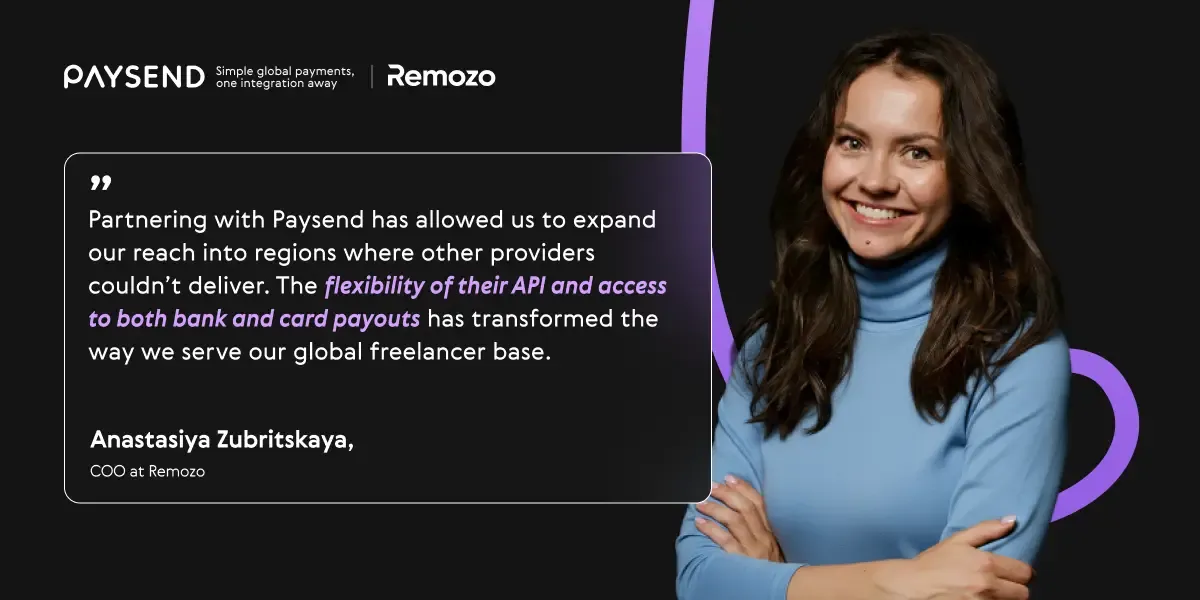
"Partnering with Paysend has allowed us to expand our reach into regions where other providers couldn’t deliver. The flexibility of their API and access to both bank and card payouts has transformed the way we serve our global freelancer base."
— Anastasiya Zubritskaya, COO, Remozo
Paysend Testimonial
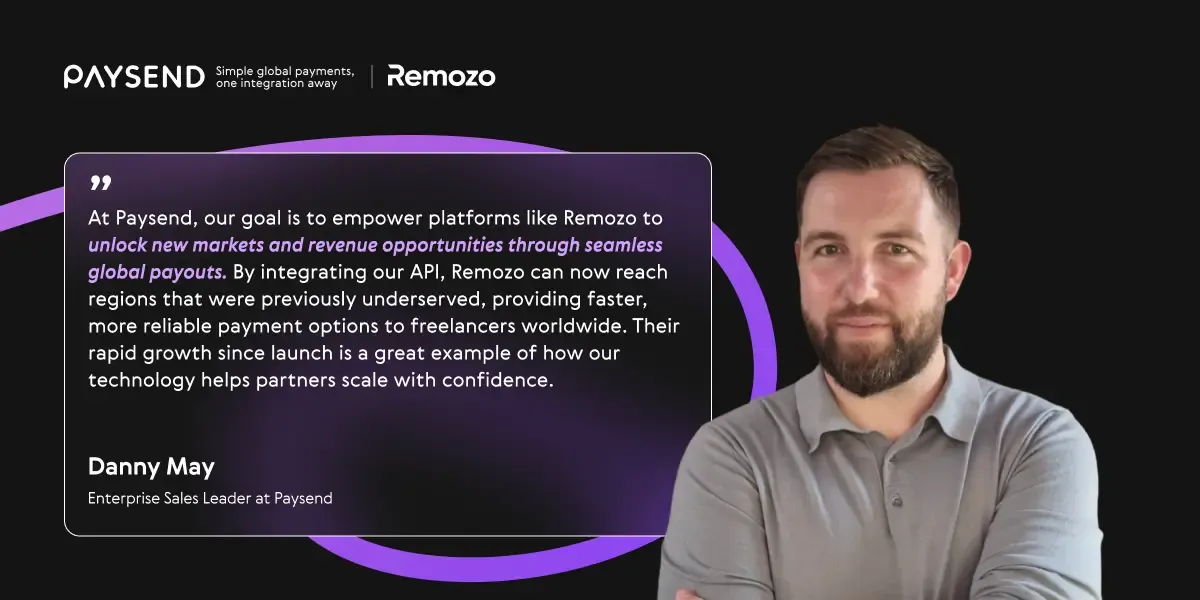
“At Paysend, our goal is to empower platforms like Remozo to unlock new markets and revenue opportunities through seamless global payouts. By integrating our API, Remozo can now reach regions that were previously underserved, providing faster, more reliable payment options to freelancers worldwide. Their rapid growth since launch is a great example of how our technology helps partners scale with confidence.”— Danny May, Enterprise Sales Leader, Paysend Enterprise.
Conclusion
By leveraging the Paysend Enterprise API, Remozo has been able to scale rapidly, enhance client satisfaction, and capture new market opportunities. This partnership demonstrates how Paysend enables Employer of Record platforms to unlock new markets, new revenues, and new ways to pay globally.
Najnowsze posty

Here's the short answer: yes, you can use a credit card to get money into someone's bank account abroad. "Credit card to bank transfer" means exactly that — you fund the transfer with your credit card, and your recipient receives it in their bank account. Or on their card, in their wallet, or as cash to collect, depending on where they are.
The card and the bank account do different jobs. Your card pays for the transfer. A provider like Paysend then pays the money out through local systems on the other end. It's one flow, and it takes about a minute in the app.
One thing worth knowing before you start: a credit card is usually the most expensive way to fund a transfer. Some issuers treat it as a cash advance, and credit tends to carry higher payment fees than debit. You'll always see the full cost, exchange rate included, before you confirm anything. What follows is: the ways your money can arrive, what each one costs, how fast it gets there, and the cheaper routes worth checking first.

Co miesiąc tysiące osób pracujących w Czechach wysyła część wypłaty do domu — wielu z nich to Ukraińcy wspierający rodzinę za granicą. A tradycyjna droga utrudnia to, co powinno być proste: przelewy bankowe wymagające IBAN i kodów SWIFT, opłaty, które widać dopiero, gdy pieniądze już zniknęły, oraz dni oczekiwania, podczas gdy ktoś w domu na nie liczy.
Pavel Štich od lat pomaga swoim czytelnikom rozwiązywać dokładnie ten problem. Jest współzałożycielem i redaktorem naczelnym ds. finansów w Moneyo.cz — niezależnej czeskiej platformie, która porównuje usługi przekazów pieniężnych, brokerów giełdowych i alternatywne inwestycje — a także Ambasadorem Paysend, co oznacza, że osobiście testuje wszystko, co poleca, wyjaśnia to prostym językiem i daje swoim czytelnikom ekskluzywne korzyści. Zapytaliśmy go, jak powstało Moneyo, kto je czyta i dlaczego wybrał Paysend.


