SME Survey – The shortcomings of business financial services
Over the summer, Paysend conducted a survey of over 250 SMEs across the UK to understand how satisfied they were with their business financial services.
At a time of significant macroeconomic uncertainty across different markets, SMEs looking to grow and expand internationally face significant challenges. Effective business financial services are the key enabler for SMEs to be successful in a highly globalised world, however, to be confident in their strategic ambitions and strive for growth, SMEs need clarity, consistency, affordability, and tailored guidance.
Unfortunately, this is clearly not the case for most small businesses. According to the survey, 7 in 10 SMEs believe that their recent growth ambitions have been negatively impacted by financial administrative processes, meaning that traditional business financial services solutions represent a barrier to growth for entrepreneurial and innovative companies to expand successfully. So, what are the key issues and where do they lie?
1. Awareness of better alternatives
Twenty-nine percent of SME respondents said that long-standing relationships with incumbent providers was one of the greatest internal barriers to improving their financial services. Related to this, 6 in 10 SMEs said they are not sufficiently aware of the different money transfer options available to them. This lack of awareness means that SMEs are settling for less and sticking with the traditional financial services providers they have always done business with. It is clear, however, that there is appetite for this knowledge gap to be closed for SMEs – competition with new digital market entrants increasing customer choice is driving higher standards for business financial services. SMEs shouldn’t settle for less.
2. Lack of internal expertise
Secondly, twenty-nine percent of SME respondents also believed that a lack of the required technical expertise internally was holding back their ability to better control their business financial services. Payments and other key financial services products are increasingly going digital for improved service levels, faster speeds, and lower costs. SMEs must accelerate their adoption of digital alternatives as consumers have in recent years to streamline their operations and accelerate growth. Fintechs hold the technical keys to unlock these opportunities for SMEs. No internal expertise required.
3. Long settlement times
Settlement times for traditional business payments are usually clunky, slow, and inconsistent, particularly when operating cross-border and in different currencies. Twenty percent of SMEs reported being dissatisfied with their settlement time periods for payments. Taking this a step further, 6 in 10 SMEs said specifically that they have cash flow issues due to the time it takes to receive sales revenue and send money to suppliers. Traditional settlement times are driving short term cash flow issues for SMEs, causing delays to transactions, supply chains and new business contracts. The huge rise of instant payment digital alternatives in recent years is transforming this issue for businesses. Choose an instant payment option, based on a digital platform, to reduce delayed payments pain and drive cash flow consistency.
4. Expensive pricing structures
Naturally, SMEs do not have the same financial firepower or balance sheet strength as larger enterprises. As a result, scaling in a cost-efficient way is fundamental to the successful growth of smaller businesses. In Paysend’s survey, it was clear that small-size companies are significantly more sensitive to the pricing of their business financial services. 36% of SMEs want this area improved with traditional business financial services often being defined by bolt-on fees and hidden charges. SMEs need transparency and affordability to drive sustainable, profitable growth. Digital solutions incorporating flat fees, fixed exchange rates and clear communication are shining a light on expensive pricing structures in this market.
Conclusion: SMEs must expect better
The successful business development and international expansion of SMEs forms the bedrock of economic growth in markets around the world. Paysend’s recent survey, however, clearly shows that the traditional financial services these SMEs rely on is hampering this growth potential. Entrepreneurs and small business owners - fear not. The emergence of fintech and digital alternatives are positively disrupting business financial services and unlocking the door to domestic and international growth. SMEs should look to explore the options available to them today.
Останні дописи

Here's the short answer: yes, you can use a credit card to get money into someone's bank account abroad. "Credit card to bank transfer" means exactly that — you fund the transfer with your credit card, and your recipient receives it in their bank account. Or on their card, in their wallet, or as cash to collect, depending on where they are.
The card and the bank account do different jobs. Your card pays for the transfer. A provider like Paysend then pays the money out through local systems on the other end. It's one flow, and it takes about a minute in the app.
One thing worth knowing before you start: a credit card is usually the most expensive way to fund a transfer. Some issuers treat it as a cash advance, and credit tends to carry higher payment fees than debit. You'll always see the full cost, exchange rate included, before you confirm anything. What follows is: the ways your money can arrive, what each one costs, how fast it gets there, and the cheaper routes worth checking first.
Щомісяця тисячі людей, які працюють у Чехії, надсилають частину своєї зарплати додому. Багато з них — українці, які підтримують свої родини в Україні. А звичний спосіб переказувати гроші ускладнює те, що мало б бути простим: банківські перекази, для яких потрібні IBAN і SWIFT-код, комісії, про які стає відомо лише після відправлення грошей, і кілька днів очікування, поки рідні вдома розраховують на цей переказ.
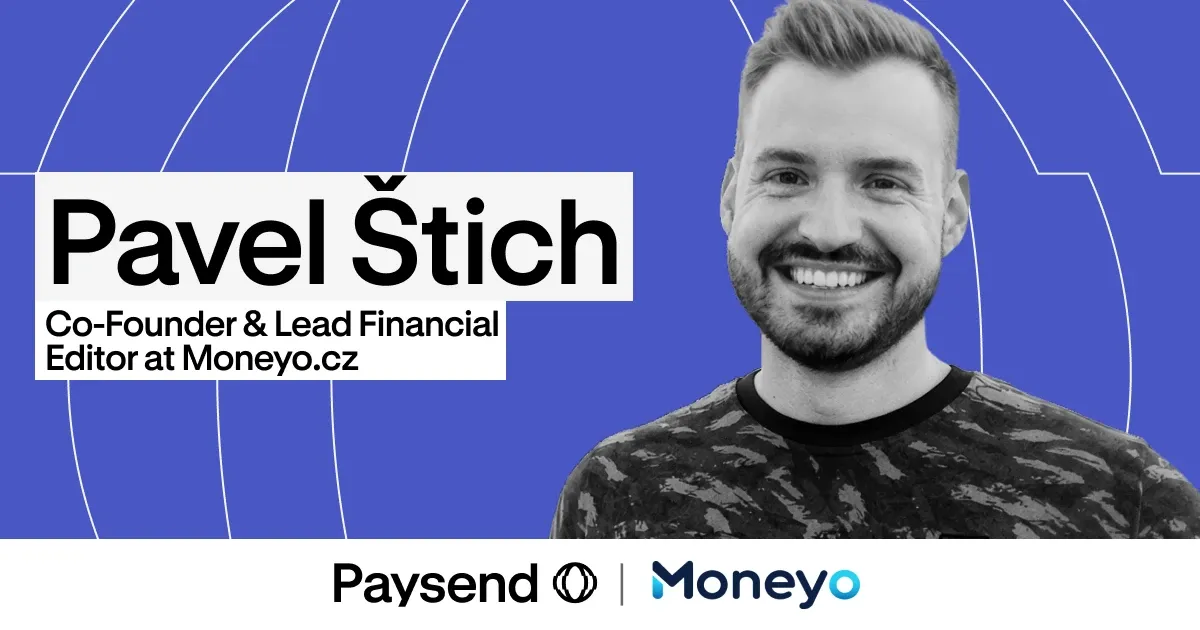
Павел Штіх уже кілька років допомагає своїм читачам розв'язувати саме цю проблему. Він співзасновник і головний фінансовий редактор Moneyo.cz — незалежної чеської платформи, яка порівнює сервіси грошових переказів і брокерів та розповідає про альтернативні інвестиції, — а також амбассадор Paysend. Він особисто тестує все, що рекомендує, пояснює складні речі простою мовою та пропонує своїм читачам ексклюзивні бонуси. Ми запитали його, як з'явився Moneyo, хто його читає і чому він обрав Paysend.


